
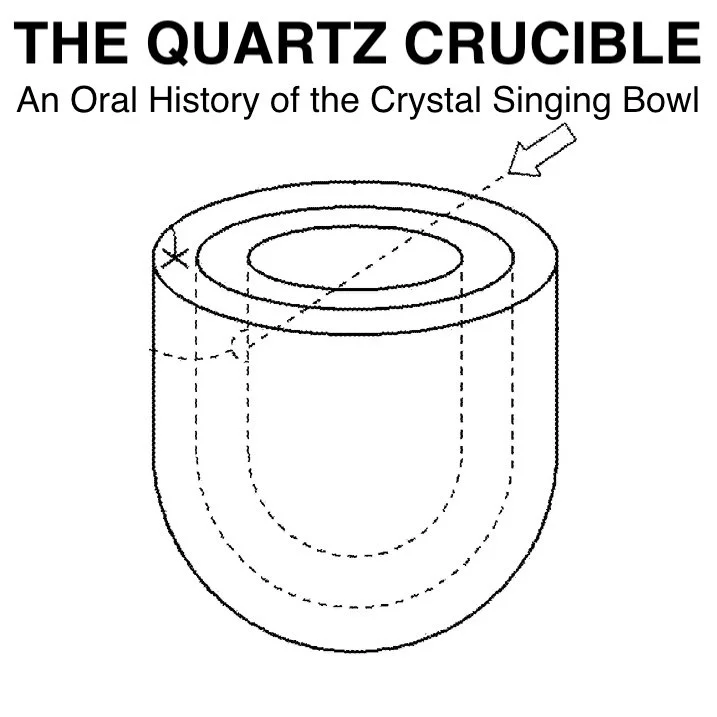
The Quartz Crucible:
an oral history of the crystal singing bowl
This story begins with excerpts from two obscure VHS tapes from thirty years ago.
The first comes from Making of a Microchip, a corporate documentary film by Texas Instruments, describing the company’s silicon wafer fabrication process:
The second is from Sound Healing and the Inner Terrain of Consciousness, a sound healing seminar from Washington-based musician Tom Kenyon:
These videos have more in common than the fact that they were both released in 1996. They also center on a shared material artifact—albeit one with two different names: the quartz crucible and the crystal singing bowl.
How exactly did this happen? When, where, why, and because of whom did quartz crucibles used as furnace liners in the production of mono-crystalline silicon ingots get repurposed as tools for sonic meditation and spiritual healing? These are the questions which drive this project.
Combining oral-historical interviews and archival footage, this documentary film project traces how The Quartz Crucible became The Crystal Singing Bowl. In doing so, it offers a radically new perspective on the shifting and interwoven political economies of information and spiritual technologies over the past century.
By exploring how a deceptively simple object—a quartz bowl—takes on fundamentally different meanings and uses in different social and material contexts, we can deepen our understanding of how our current socio-technical order was forged at the intersection of the New Age and the Information Age.
Filmmaker Bio:
Owen Marshall is a researcher in the interdisciplinary field of Science and Technology Studies. He specializes in the history and sociology of sound and listening practices as ways of understanding and intervening in the world. He has written about how techniques and equipment from ham radio shaped research on insect feeding behavior, how recording engineers and military psychologists both used tape echo to transform how they understood emotion, and how the oil industry influenced the development of Auto-Tune and other technologies of the voice.